Skip to content

You’re planning a commercial scheme in Dublin. Before you lock in a design or brief a contractor, you need to understand what commercial site development cost actually runs, what moves the numbers, and how to budget realistically.
In Dublin, site development costs between €150 and €400 per square metre. Most projects land around €200 to €300. Ground conditions, site access, drainage needs, and demolition or contamination work are the main drivers.
We work across Dublin, Kildare, Louth, Meath, and Cavan on commercial groundworks and site development, and the pricing patterns below reflect what we’re seeing on live projects in 2026.
What Does Commercial Site Development Actually Include?
Commercial site development covers every stage of preparing a plot for construction, from clearing the ground to handing a level, serviced, and compliant site to the main contractor. It usually includes demolition, excavation, drainage, utilities, sub-base, and access works. Fit-out and superstructure are separate line items.
On a typical Dublin commercial project, the site development package will run through the following stages:
- Site clearance and demolition including removal of existing structures, vegetation, and hardstanding.
- Bulk excavation and muck-away, which is often one of the largest single costs on tight urban sites.
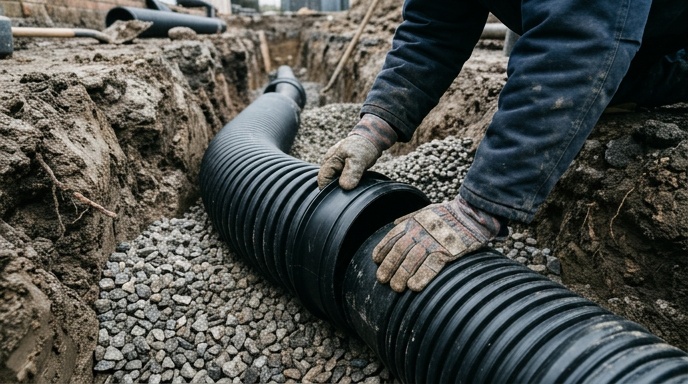
- Foul and surface water drainage, including attenuation systems where SuDS compliance is required.
- Utility connections for ESB, gas, water, and telecoms ducting.
- Roads, footpaths, kerbs, and car park build-up to council specification.
- Landscaping and boundary treatments including walls, fencing, and gates.
Where the site sits next to public infrastructure, you’ll also have footpath replacement and road reinstatement to comply with council standards. If you want the detail on that specific piece of work, our footpath replacement covers the specification councils expect.
What Drives the Price Per Square Metre in Dublin?
Ground conditions and access are the two biggest cost movers on a Dublin commercial site. A site with good bearing capacity, easy vehicle access, and shallow services can come in near €150 per square metre. A site with soft ground, rock, or contaminated fill can push costs past €400 per square metre before you’ve laid a single block.
Ground Conditions and Contamination
Made ground is common across older Dublin industrial and dockland sites. If your geotechnical survey shows contaminated fill, you’re looking at soil testing, licensed removal, and possibly imported engineered fill.
This alone can add €30 to €80 per square metre to the base cost. On brownfield sites near the Port or older industrial estates, budget for it early.
Site Access and Working Space
A restricted city-centre site with no lay-down area, single-lane access, and out-of-hours working restrictions costs more to service than an open Fingal or Meath plot. Smaller plant, more trips, and longer programme durations all push the rate up.
Drainage and Attenuation Requirements
SuDS (Sustainable Urban Drainage Systems) compliance is now standard on Dublin commercial developments. Attenuation tanks, permeable paving, and interceptors typically add €15,000 to €80,000 depending on the impermeable area and discharge rate the council allows.
Typical Cost Ranges for Common Commercial Project Types
Below are indicative Dublin ranges for common commercial site development scopes. These are budget guides, not fixed prices, and every project needs a proper site-specific quote.
- Small commercial car park (500 to 1,000 sqm) including sub-base, tarmac, drainage, and line marking, roughly €90,000 to €200,000.
- Warehouse or logistics unit external works (2,000 to 5,000 sqm), including yard, drainage, and utilities, roughly €400,000 to €1.2 million.
- Retail or mixed-use urban site (1,000 sqm) with demolition, contaminated soil removal, and full services, roughly €300,000 to €600,000.
- Office development enabling works, from clearance to slab-ready, typically €200 to €350 per square metre.
Public sector projects, such as council-led social housing enabling works or infrastructure schemes, follow tender pricing frameworks. Our commercial site development delivered civil works for Dublin City Council, Fingal County Council, and Dublin Port, and the pricing model there is more prescriptive than private commercial work.
Which Costs Do Clients Most Often Underestimate?
The three most commonly missed line items on Dublin commercial site budgets are utility connection fees, council bond payments, and off-site works. Together these can add 10% to 20% to a project total that only counted physical construction. Build them in from day one and you’ll avoid a mid-project scramble for cash.
Utility Connection Fees
ESB Networks, Uisce Éireann, and Gas Networks Ireland all charge substantial connection fees for new commercial connections. A three-phase ESB connection alone can run into tens of thousands depending on capacity and distance from the network.
Uisce Éireann’s charges for new water and wastewater connections are published and worth checking early. You can review the official connection charge guidance from Uisce Éireann before finalising your budget.
Council Bonds and Compliance
Most Dublin local authorities require a security bond before commencement of works that touch the public realm. This covers reinstatement of roads, footpaths, and services. Bonds can range from a few thousand to several hundred thousand euro depending on the scale of interface with public infrastructure.
Off-Site Road and Footpath Works
If your planning permission requires you to upgrade the footpath outside your site, provide a new pedestrian crossing, or reinstate a road after utility works, that’s your cost. It’s routine on Dublin commercial projects and it’s easy to overlook until the council starts asking.
How Long Does Commercial Site Development Take?
Programme duration for Dublin commercial site development typically runs from 8 weeks for a small car park to 9 to 12 months for a large mixed-use or logistics scheme. Weather, ground surprises, and utility provider lead times are the three most common causes of delay.
Realistic sequencing on a mid-sized commercial job looks like this:
- Site set-up, hoarding, and clearance, usually 2 to 3 weeks.
- Demolition and bulk excavation, 3 to 8 weeks depending on volume.
- Drainage, attenuation, and deep services, 4 to 10 weeks.
- Utilities and ducting, running in parallel with drainage where possible.
- Sub-base, kerbs, footpaths, and surface finishes, 4 to 8 weeks.
Utility provider lead times are the silent killer on programme. ESB and Uisce Éireann connection applications should go in as soon as planning is granted, not when you’re ready to dig. That single move can save you six to twelve weeks on site.
How Can You Reduce Commercial Site Development Costs?
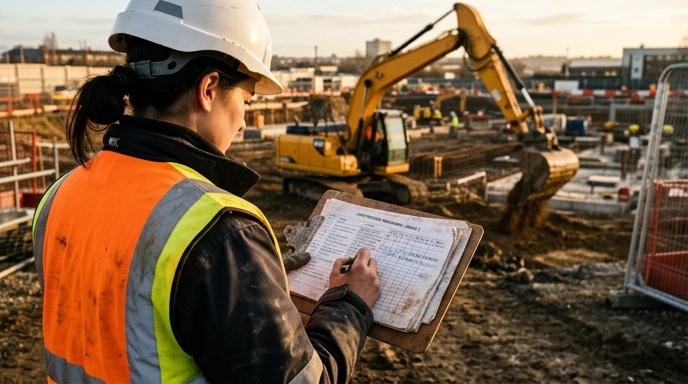
The biggest cost savings on commercial site development come from early contractor involvement and thorough pre-construction investigation. Get a groundworks contractor around the table at design stage, not tender stage, and you’ll design out expensive surprises before they hit the site.
- Commission a proper geotechnical survey before finalising the design. A €5,000 survey can save €50,000 in redesign and unexpected muck-away costs.
- Coordinate utility applications early to avoid programme extensions and standing charges.
- Consider cut-and-fill balance on level design to reduce muck-away volumes, which is one of the largest single costs on urban sites.
- Use permeable paving where possible to reduce attenuation tank sizing and drainage costs.
- Sequence enabling works with the main build so plant and welfare costs are not duplicated.
Planning conditions are another area where money leaks quietly. Read every condition carefully and price them explicitly. The Dublin planning environment increasingly loads compliance costs onto developers, from ecology surveys to construction management plans. The Department of Housing guidance on planning and development is a useful starting point when you’re checking what’s likely to apply.
What Should Be Included in a Site Development Quote?
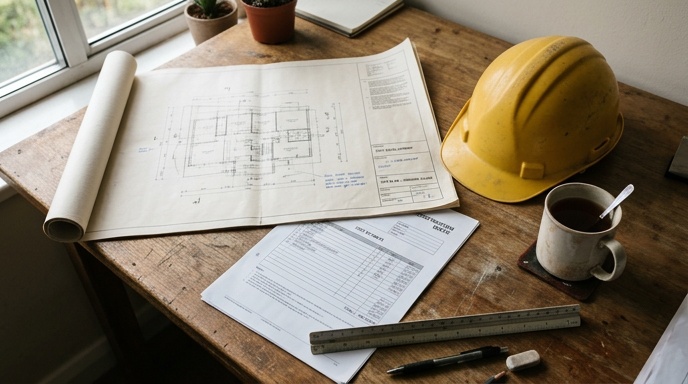
A proper commercial site development quote should be itemised by work package, not a single lump sum. If you receive a one-line figure, ask for the breakdown. Transparency at quote stage predicts transparency at final account stage.
Look for these line items in any quote you review:
- Preliminaries, insurances, and site set-up costs stated separately.
- Demolition and clearance quantified by area or building.
- Excavation broken down by cut, muck-away, and imported fill.
- Drainage priced by linear metre with attenuation as a separate figure.
- Utilities showing ducting and any allowance for provider fees.
- Surface works split by material and area.
- Provisional sums clearly marked for unknowns like contamination.
A quote without provisional sums for the unknowns is not a realistic quote. Every Dublin site has unknowns until the ground is opened, and a good contractor will price for that honestly rather than absorb it into a low headline number and claim it back through variations later.
If you’re planning a commercial development anywhere in the Greater Dublin area and want a proper, itemised site development quote that reflects real ground conditions, get in touch with our team for a site visit and detailed budget breakdown.