 Skip to content
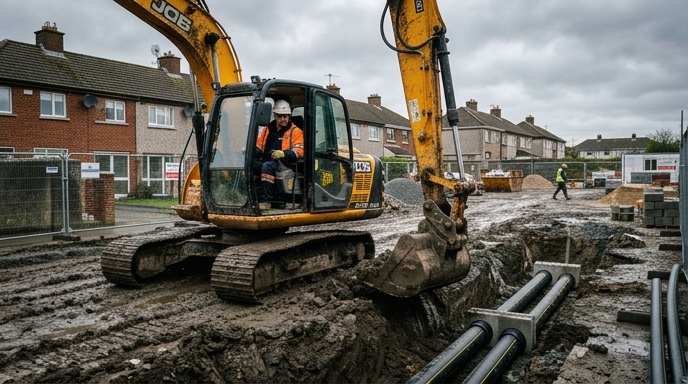
Finalizing civil engineering contractor cost in Ireland is one of the bigger decisions on any development, whether you’re a homeowner laying foundations for an extension or a developer preparing a site for new housing. Prices vary widely because no two jobs sit on the same ground, and that catches a lot of people off guard.
As a broad guide, civil engineering contractor costs in Ireland typically range from €450 to €900 per day for a two-person crew with plant. Full project pricing runs from €15,000 for small residential groundworks up to several hundred thousand for commercial site development. The final number depends on scope, ground conditions, access, and how much muck has to leave the site.
Below, we break down what drives those figures, what a fair quote should look like, and where the hidden costs usually turn up.
What Does a Civil Engineering Contractor Actually Do?
A trusted civil engineering contractor in Dublin handles the works efficiently that happen before a building goes up and around it once it’s built. That covers excavation, drainage, foundations, utility connections, hardstanding, and site preparation. On public jobs, it also includes footpaths, kerbing, road construction, and water networks.
The work sits between design and structure. An engineer or architect specifies what needs to happen underground and at ground level, and the contractor delivers it on site with plant, materials, and skilled labour.
- Groundworks and excavation for foundations, basements, and drainage runs
- Drainage installation including foul, storm, and attenuation systems
- Utility trenching for ESB, gas, water, and telecoms ducts
- Concrete works including footings, slabs, and retaining structures
- Site clearance and muck-away for redevelopment or new builds
- Footpath, kerbing, and road construction for public and private schemes
Because the works are largely hidden once the project finishes, standards matter more than appearances. A well-executed drainage run costs more upfront but saves years of trouble later.
How Much Do Civil Engineering Contractor Cost in Ireland?
Civil engineering pricing in Ireland is usually quoted either as a day rate for a defined crew and plant, or as a fixed price for a measured scope of work. Day rates suit small or unpredictable jobs. Fixed-price tenders suit anything with a clear specification and drawings.
Typical Day Rate Ranges
Day rates cover the crew, machine hire, fuel, and basic consumables. They don’t usually cover imported materials, waste disposal, or specialist plant. For most residential and small commercial projects around Dublin, expect the following:
- Two-person crew with a 3-tonne excavator around €450 to €650 per day
- Two-person crew with a 6 to 8-tonne excavator and dumper around €700 to €900 per day
- Larger crews on commercial groundworks from €1,200 per day upwards
- Specialist plant like rock breakers or long-reach machines charged separately
Typical Project Pricing
Fixed-price quotes are more common on defined jobs. Rough ranges for common project types in the Greater Dublin area look like this:
- Small residential groundworks for an extension foundation, from €15,000 to €35,000
- Full site preparation for a new build home, from €40,000 to €90,000
- Drainage upgrades and connections, from €8,000 to €25,000
- Commercial site development for small units, from €150,000 upwards
- Public footpath and kerbing schemes, priced per linear metre based on tender documents
These are indicative and shift with material prices, ground conditions, and scope. Always get at least two written quotes on the same specification.
What May Change Contract Cost?
Two civil engineering quotes for the same job can differ by 30% or more, and it’s rarely because one contractor is cheating. Ground conditions, access, and design detail move the price far more than the daily crew rate does.
1. Ground Conditions and Site History
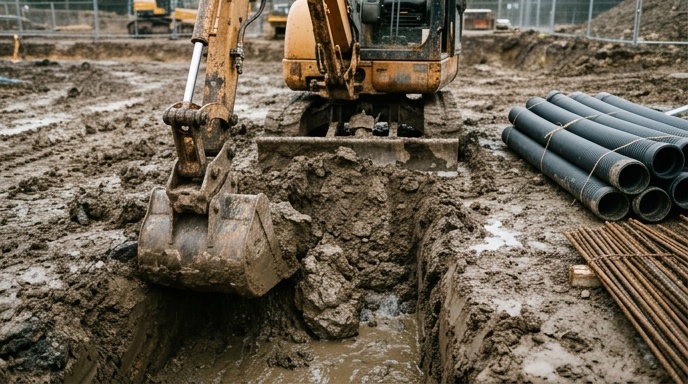
Rock, high water tables, made ground, and contaminated soil all add cost. If a machine has to break through limestone or work below the water table with pumps running, productivity drops sharply. Made ground from a previous demolition often has to be tested and disposed of as classified waste, which can add €10,000 or more to a modest job.
2. Access and Working Space
A tight urban site with no room for a dumper or spoil heap means every load has to be handled twice. Contractors price this in. A greenfield site with wide access will always come in cheaper for the same volume of work.
3. Design Detail and Specification
- Reinforced concrete costs more than mass concrete due to steel and labour
- Attenuation tanks and soakaways add cost where mains drainage is limited
- Deep foundations or piling change the pricing category entirely
- NZEB and Part L compliance often requires thicker insulation and detailed junctions
The Health and Safety Authority also sets clear duties for construction projects, and compliant contractors price time and PPE into their rates. You can review the official construction safety guidance to understand what a proper site setup should include.
What Should Be Included in a Civil Engineering Quote?
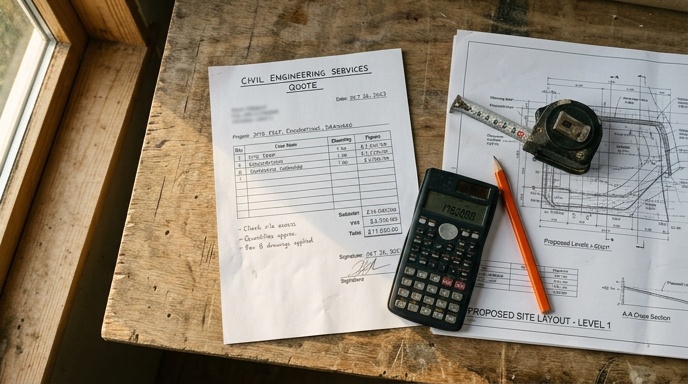
A proper quote is a document, not a text message. It should list every element of work, the assumptions behind the price, and what happens if something changes on site. Vague quotes almost always lead to disputes later.
Look for these items on any written quote:
- A clear scope of works tied to specific drawings or specifications
- Muck-away volumes with a rate per load if quantities change
- Materials schedule for concrete, aggregate, pipes, and fittings
- Plant and labour broken out where possible
- Provisional sums for anything unknown, such as rock or contaminated soil
- Programme showing start date, key milestones, and completion
- Payment schedule tied to stages of work, never fully upfront
- Insurance details including public liability and employer’s liability
If any of these are missing, ask for them before you sign. A reliable contractor quote will manage the job properly.
How Do Public Sector and Private Projects Differ on Cost?
Public sector civil works, such as council footpath schemes or drainage contracts, are priced through formal tender procedures. Private projects, from a homeowner’s extension groundworks to a developer’s site prep, are usually priced through direct quotation. The pricing logic behind them differs in a few key ways.
Public tenders require documented compliance with procurement rules, health and safety plans, and often bonds or parent company guarantees. That administrative overhead lifts the base price, but it also means the specification is watertight and variations are managed formally.
Private jobs are quicker to price and start but carry more risk of scope creep. Homeowners in particular should treat verbal add-ons with caution and get every change in writing before work proceeds.
- Public schemes priced on Bills of Quantities with measured rates per item
- Private residential priced as a lump sum with day rates for extras
- Commercial development often uses a mix of both approaches
- Subcontract work to main contractors priced on schedule of rates
If you’re a private client, remember that a contractor experienced in public works usually brings that discipline to residential jobs too. That’s often worth paying a small premium for.
How Can You Keep Civil Engineering Contractor Costs Under Control?
Cost control on civil works starts before the first digger arrives. Once excavation begins, options narrow quickly. The homeowners and developers who come in on budget are the ones who invested time in preparation and clear communication upfront.
1. Get a Proper Site Investigation
A basic ground investigation report, typically €1,500 to €4,000 for a small site, tells you what’s under the surface before you commit. Surprises found mid-dig are the single biggest cause of cost overruns on civil jobs.
2. Fix the Design Before Pricing
Chopping and changing drawings after work starts is expensive. A design that’s fully coordinated between architect, structural engineer, and services designer costs more to produce but saves multiples of that on site.
3. Choose the Right Contractor for the Job
- Check relevant experience in similar ground conditions and scale
- Ask for references from recent projects and follow up on them
- Confirm insurance and tax clearance are current before contract signing
- Meet the site foreman, not just the sales contact, before appointing
For further reading on how construction projects are structured and what to expect from contractors, the Citizens Information guidance on building or altering a home is a useful starting point for private clients.
When Is a Civil Engineering Contractor Worth the Investment?
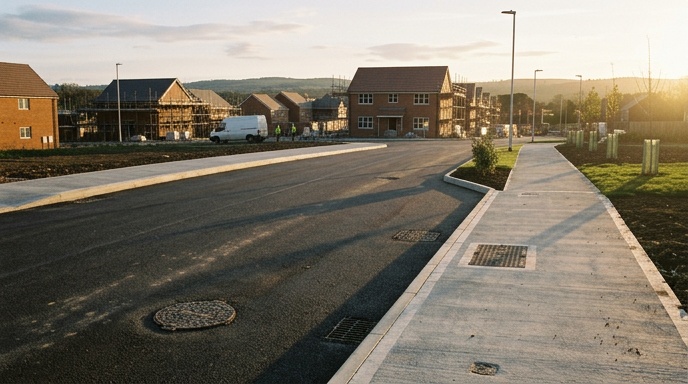
For anything beyond a garden path, a qualified civil engineering contractor is worth the money. Bad groundworks are almost impossible to fix without pulling apart what sits on top. That’s why councils, developers, and experienced homeowners treat this stage as the most important part of the build.
The right contractor gives you a fair, itemised price, works to a proper programme, and leaves the site ready for the next trade without any nasty surprises underground. If you’d like a detailed quote for civil engineering, groundworks, or site development in Dublin or the surrounding counties, get in touch with our team for a site visit and written proposal.


